Week 4
Homework
Title: Metals and Non-metals

Before we discover how atoms join together to make compounds, we need to get to know the atoms themselves! 🧪⚛️ One of the first things scientists look at is whether an element is a metal or a non-metal. But what makes them different? Why can some metals conduct electricity, bend, and shine, while many non-metals behave very differently? 🔌✨ Understanding these two big groups will give you the tools you need to figure out how atoms interact, why they bond, and how completely new substances are formed. Get ready to become an atomic detective and uncover the patterns hiding in the Periodic Table!
1. First, watch this video about metals and nonmetals and create a list of the characteristics of the metals and non-metals in your notebook:
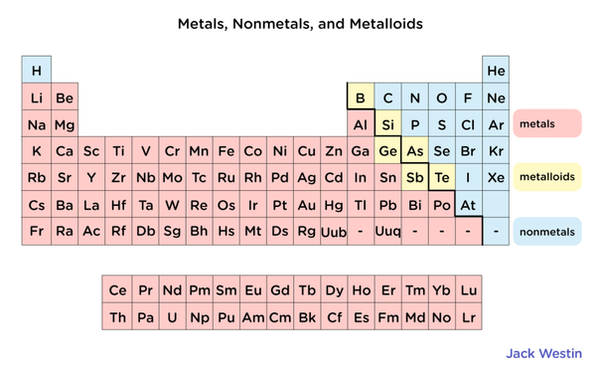
2. Using the image below, Write and complete the following sentences in your notebooks:
-
Most of the elements in the periodic table are classified as ______________ (metals, non metals or metalloids?, which ones are more abundant in the table?)
-
Metals are located in the ______________ side of the table
-
Non-metals are located in the ______________ side of the table
-
Three examples of metals are: _______________, ___________ and ___________
-
Three examples of non—metals are: __________, ___________ and __________
3. Choose 3 elements from the Periodic table (make sure you have one metal, one non metal and a metalloid) and complete the following information in your notebook:
Element:
Symbol:
Z:
Classification: Metal, non-metal or metalloid
Group: (Column # in the periodic table)
Period: (Row # in the periodic table)
The purpose of this class is to learn the difference between an element and a compound and the way in which simple compounds are named.
The class will start with an explanation of the rules to name compounds:
Then, we will watch a video that helps us clarify the questions we may have about the topic:
Finally, we will solve the following classwork:
1) Describe two ways in which sodium chloride is different from chlorine
2) Which two elements are combined to make these compounds?:
a) Sodium chloride
b) Hydrogen sulfide
c) Magnesium oxide
3) A student wrote this name for a compound made of calcium and sulfur: sulfur calcium. What is wrong with this name? Write the correct name for the compound
4) Which three elements are combined in: (write the name of the 3 elements present in each of these compounds)
a) calcium nitrate
b) magnesium carbonate
c) lithium sulfate
During this class, we will practice
naming compounds with 2 or 3
elements and we will also practice
how to write the chemical formula
of simple compounds.
Every compound has a chemical name and a chemical formula. The formula contains the symbols of the elements that are bonded together in the compound. Next to the symbol (in the right part), we can find a little number that indicates the number of atoms of that element found in one molecule of the compound. If there is no number. that means there is just one atom of that element.
Examples:
CO2 has one atom of carbon bonded to two atoms of oxygen
H2S has two hydrogen atoms bonded to one sulfur atom
Hydroxides
There is one more kind of compound that you need to know about. These are the hydroxides. These are compounds that contain one element plus hydrogen and oxygen (OH). These substances are strong alkalis, or the opposite of acids because they have a high pH. Its name and formula its always the name of the other elements + hydroxide:
Sodium hydroxide = NaOH
Let's practice the names and formulas of different compounds by solving this activity:
Solve this activity in your notebook under the title "Naming Compounds Classwork"
1) Name the following compounds according to the rules studied in class:
KBr: _____________________________________________________
CaO: ____________________________________________________
LiI: ______________________________________________________
NaBr: ____________________________________________________
MgO: _____________________________________________________
KOH: _____________________________________________________
CaCO3: __________________________________________________
2) Write the formula for the following compounds:
Rubidium hydroxide
Carbon monoxide
Nitrogen monoxide
Nitrogen dioxide
Dinitrogen trioxide
Aluminium hydroxide
Sulfur hexafluoride
Boron phosphide
Diphosphorus pentoxide
3) Complete the table using the name, formula, the number of atoms and elements present in the compound, and the total number of atoms the compound has:
4) Let’s “Create” New, Non-Existent Compounds!
Get creative and invent 10 compounds that don’t actually exist! 🔬✨
⚠️ Remember: Not every atom can combine with every other atom in real life. For this activity, however, we are going to ignore those rules so you can practise naming compounds.
For each of your 10 compounds:
-
Choose one metal and one non-metal from the Periodic Table.
-
Write their chemical symbols in the correct order: metal first, non-metal second.
-
Add a different number (subscript) to each element's symbol so that you can practise using different prefixes when naming compounds.
-
Look up the names of the elements you chose.
-
Use the rules for naming compounds to give your new compound a name.
-
Be creative—the more unusual your imaginary compounds are, the better!


Video activity
Class 2: Compounds


Class 3: Formulae



OPEN THIS PERIODIC TABLE SO YOU CAN SEE THE INFO YOU NEED: