

Class 1: Moving our body
🦴💪 Welcome to Joint Forces!
Get ready to bend, twist, and flex your way into today’s
exciting science lesson! Have you ever wondered how
your arms move when you throw a ball, wave hello, or
lift your backpack? Today, we’re diving into the amazing
world of joints and muscles! You'll explore two special
types of joints — hinge joints (like your elbow) and
ball-and-socket joints (like your shoulder) — and discover how your muscles team up in pairs to pull your bones into action. By the end of class, you’ll understand how your body is built for motion, and maybe even feel like a mini-biologist yourself. Let’s get moving! 🧠🦴⚙️
1) Watch the following video and answer these questions in your notebook as you do it:
a) What are joints?
b) What do tendons and ligaments connect?
c) Write the 3 main types of joints, explain them with a couple of words and some examples of where can we find them
d) What are cartilages?
e) Why do some bones crack?
f) Mention an injury that can affect joints
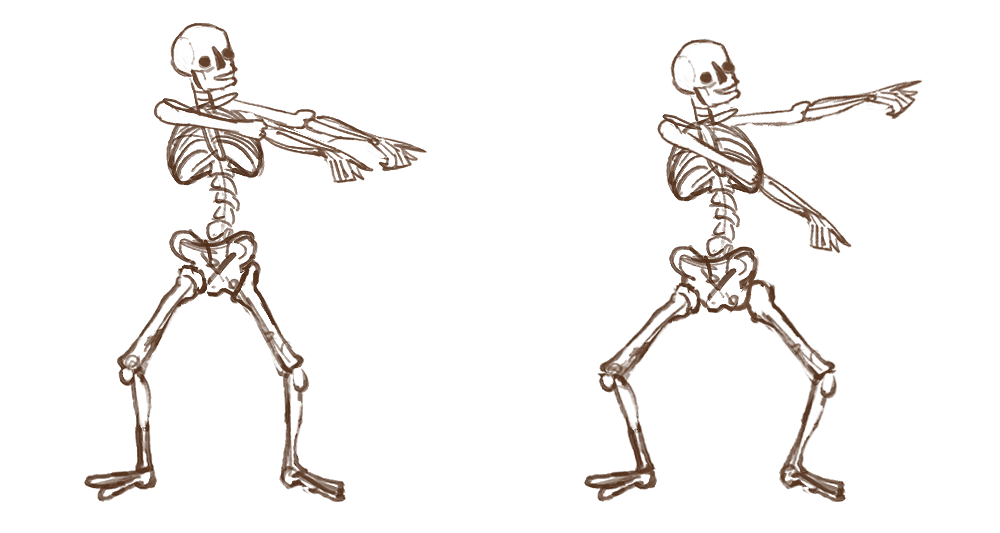
2) Paste the skeleton image in the notebook and label its main bones:
Use this presentation to see the names of the bones we will learn today.
We will finish the class with a small kahoot to check the names of the bones:
Bones and joints cannot move themselves. You use muscles to move
bones at joints. Muscles are made of specialised cells. These cells are able to make themselves shorter. This is called contraction
Muscles use energy to contract. Like all cells, they get this energy from
nutrients, especially glucose. The energy is released from glucose by
respiration. The more you ask your muscles to contract, the more energy
they use, and therefore the more glucose they use.
1) Watch the video about the way in which muscles work and define agonist and antagonist muscles, explaining how the biceps and triceps work to bend the arm:
2) Look at the diagram and use this information to answer these questions:
a) The biceps is attached to the
scapula at one end. Which bone is
the other end attached to?
c) Which bones is the triceps
attached to?
d) Tri- means three. Suggest why
the triceps has this name.
e) Tendons are not stretchy.
Suggest why.
3) Visit the BBC website and find besides the biceps and triceps muscles, what other antagonistic muscles can we find in the body? Where are they located?
Week 10


Class 2: Muscles





Click Here
The circulatory system is like a busy city inside
our bodies. It has a network of roads, just like
the system of arteries and veins that carry blood.
The heart acts as the city center, pumping blood
to all parts of the body. Think of the heart as a big
central station that sends out buses (blood) to
different neighborhoods (organs and tissues).
Our blood delivers oxygen nutrients to every cell,
just like streetlights light up every corner of the city.
The white blood cells arelike city guards that
protect against germs and invaders,
while the platelets are like repair crews
that fix any damage. With each heartbeat, the city
comes alive, and the blood flows through the streets,
providing energy and nourishment to keep the city running smoothly. It's an amazing system that keeps our bodies healthy and functioning, just like a city bustling with life.
We will learn what makes up our blood and what are the 3 types of cells we have on it.
Our main class goal will be:
Before doing the activity Let's watch an interesting video about our blood:
As a way to summarize what we will learn, the teacher will explain the main 3 parts of the circulatory system:
1) Visit the VEDANTU website and for the 3 types of blood vessels write: what type of blood do they transport? (oxygenated or deoxygenated), from where to where do they transport blood? How thick are they?
2) Draw the following diagram with the blood components, add plasma as a 4th component. Then visit the same website from the first point and summarize the main function of each of these components.
3) Go to the Twinkl website and write 2 fun facts about blood
4) The group will play the Kahoot to check what they learned:
After finishing this activity, we will take the mock test
Class 3: Blood


Describe the components of blood and their functions (limited to red blood cells transporting oxygen, white blood cells protecting against pathogens and plasma transporting blood cells, nutrients and carbon dioxide)


