Our body works like the most perfect machine:
getting the energy we need, getting rid of the
things it doesn't need anymore or just by
making sure we have a balance of nutrients,
wastes, temperature, oxygen and many other
basic needs.
Our bodies have different systems that work
together to keep us alive and healthy. Each
system has its own unique job to do, but they
all rely on one another to keep everything running smoothly.
In this unit, we will explore the different body systems, from the digestive system that turns food into fuel, to the excretory system that helps us have a balance of substances in the body. We will learn about the organs that make up each system and discover how they work together to help us function every day.
So, let's get started on this exciting journey through the human body systems! You never know what amazing discoveries we might make along the way!
Your digestive system is like a giant food processor, breaking
down your meals into tiny pieces so that your body can absorb
all the nutrients it needs.
Think of it like a factory that transforms raw materials into finished
products. Instead of using machines, your digestive system uses
organs like your mouth, stomach, and intestines to break down and
process food. And just like a factory, there are many different steps
and workers involved in this process!
So, get ready to explore the amazing world of the digestive
system, where we'll learn about the different parts of the
process, and how your body turns your meals into energy
and nutrients that keep you strong and healthy!
Let's solve the following activities:
1) Watch the video from KIDSHEALTH to learn more about the path that food goes through during digestion: write the names of the organs/parts the food goes through.
2) Paste the diagram of this system in your notebook, color the parts and label their names.
3) Go to the LUMEN website and write the function of the main organs: mouth, esophagus, stomach, small and large intestines, pancreas and liver. Try to SUMMARIZE the information in a way that you understand it without having to write everything.
4) In the Kids.britannica website , under the esophagus information, find and answer: what is peristalsis and where does it take place?
5) In the Natgeokids site, look for the
word "Epiglottis" what is this? is it important?
During this class, we will learn more about these bone-like structures that allow us to have mechanical digestion of food, by cutting, grinding and tearing food.
Let's watch this introductory video from Study.com:
1) Write the name of the 4 types of teeth. Choose a different color for each type of tooth and use the information from the BYJUS website to color them according to the type of tooth:
2) The diagram doesn't include the wisdom teeth (cordales), which are some special molars that appear when people are around 18 years old. How many teeth of each type do we have if our 4 wisdom teeth appear?
3) In the KidsBritannica website, use the information under the title "Types of teeth" to describe the function of each type of tooth. In parenthesis, write the translation the words into Spanish.
Incisors:
Canine:
Premolars:
Molars:
4) The shape and number of teeth we have, depend on our
diet. Some animals have more canines or bigger molars
because they need them according to what they eat. It's not
the same if you are a Giraffe that eats plants all day, as if you
are a lion that needs to eat raw meat which is not so easy to
chew. Visit the MCDC website and complete this
table in your notebook:
5) Based on what you learned in Activity 3, write which type of tooth you would primarily use for chewing each food and why? You can present the answers through a table like this:
FOODS:
6) Humans are born with two sets of teeth during their lifetime.
Look carefully at the image or model of a baby’s skull and
observe the teeth. Notice that some permanent teeth
are forming underneath the baby teeth.
Visit the SmiletoImpress site and answer:
Why do we need baby teeth?
Have you ever wondered how the food you eat gets broken down into smaller pieces that your body can use? That's where digestive enzymes come in!
Digestive enzymes are special proteins that help break down
the food you eat into smaller molecules that your body can
absorb and use for energy. Without digestive enzymes, your
body wouldn't be able to get the nutrients it needs to function
properly. So, the next time you take a bite of food, remember
that your body has an amazing system in place to help break
it down and get the nutrients it needs!
1) Visit the Kids.Britannica website and answer, what is an enzyme?
2) There is a graphic way to show how enzymes work. Visit the SciencelearnHub and draw the example of the enzyme that breaks sucrose (a type of sugar) into its 2 components.
3) Our body has different types of digestive juices. They are called "juices" because they contain a mixture of several enzymes. In the same website, scroll down to the table that shows the 5 digestive juices food will face during its pass through the digestive system. Write the name of each juice and 2 enzymes we can find on it, saying what is the kind of molecule they digest. Example: Maltase is the enzyme that digests the sugar called maltose.
4) Use any Search engine and/or the websites used in points 1 and 2 to answer: Why are enzymes important for our bodies to work properly?
5) Lactose intolerance is a syndrome caused by the lack of a specific enzyme. Go to the Mayoclinic website, read about this common condition and answer with your own words:
a) What causes it?
b) What are its symptoms?
c) What's the treatment?
6) Enzymes are super specific, this means that an enzyme can only act on a specific molecule and not on others. Check this GIF image of an enzyme and explain it. Then, draw a possible molecule that could be a match for the enzyme:



Human Body Systems

Class 1: Digestive System

Class 2: Our Teeth


Class 3: Enzymes
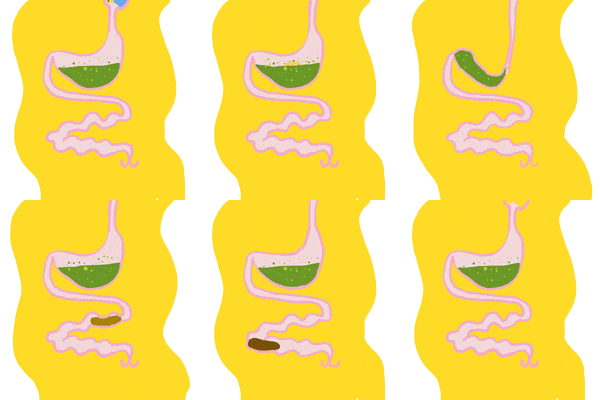
Name of the juice
List of enzymes
Each enzyme can act on a specific type of nutrient