WEEK 11
Welcome to the fascinating world of the respiratory system! The respiratory system is an essential part of our body that enables us to breathe and live. It is a complex system made up of various organs, muscles, and tissues that work together to bring oxygen into our body and remove carbon dioxide.
Breathing is an automatic process that we don't even think about, but it is crucial for our survival. Without oxygen, our cells wouldn't be able to function, and we wouldn't be able to carry out our daily activities. So, let's take a moment to appreciate the incredible breathing process and learn more about how the respiratory system helps us stay alive and healthy!
1) Color and label the diagram about the respiratory system:
2) Visit the websites CK12.org and Libguides and use the information from the diagram to match the parts of the respiratory system with their characteristics:
Gas exchange happens in the ____________________
Food and air pass through here (common name: throat) ___________________
Also called voicebox, the vocal cords are here _________________
Muscle responsible for the expansion of the lungs, and thus breathing _________________
Tube that transports the air from the larynx to the lungs, also called windpipe _________________
They are the 2 branches in which the trachea divides, one for each lung ________________
They are little branches in which the bronchi divide _________________
3) In the CK12.org website read and answer: what is the job of the nose when we breathe in?
4) Choose one of these 3 questions and answer it in your NB:
A classmate says that lung muscles cause the lungs to move
during breathing. Do you agree with your classmate?
How do the respiratory system and the cardiovascular system work together?
Breathing is an involuntary action. Does this mean that you
cannot control your breathing?
Not so clear yet? Visit the Kidshealth website and go through the slides to check how the breathing process takes place.
The amount of air that you move in and out of your
lungs depends on how quickly you are breathing.
The amount of air that is moved in and out of the
lungs when a person is breathing normally is called
the tidal volume. This amount of air provides enough
oxygen for the body when the person is resting. It is
possible to inhale more deeply and exhale more
forcefully than usual.
The maximum amount of air moved in and out of the lungs when the deepest possible
inhalation is followed by the strongest possible expiration is called the vital capacity.
Today we will have a short lab practice in which we will evaluate the factors that influence our vital capacity and we will compare the lung capacity of some of the class' students.
1) Measure the tidal volume of 6 different girls from the
classroom following the teacher's instructions. This is the
normal amount of air you normally breathe out (without
making an extra effort). You will measure the tidal volume
three times and then, calculate the average.
Record the results in a table:
2) Why is it important to measure the tidal volume more than once for each girl, and then calculate the average?
3) Now, calculate the vital capacity (maximum amount of air in an exhalation) for the same girls and complete the table with the results. The last column of the table refers to how much physical activity (sports, training, gym) the girl performs in a week from 1 to 10, being 1 none physical activity, and 10 when the student does physical activity 5 or more days per week.
3) List some possible sources of error that could occur during this experiment
4) Is there a relationship between the amount of exercise the students practice and the volume of air they can fit in their lungs?
5) Do you think the person with the greatest vital capacity can hold their breath longer than those with a lower vital capacity? Test your hypothesis with the students that got the largest and the smallest vital capacities.
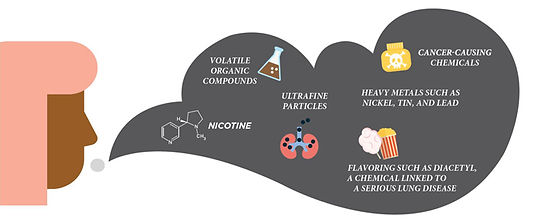
In recent years, the use of e-cigarettes has become
increasingly popular among teenagers, with many
viewing them as a safer alternative to traditional
cigarettes. However, the rise of e-cigarettes has
also raised concerns among health experts, who
warn that these devices may pose a hidden danger
to the health of young people.
While e-cigarettes are often marketed as a "safer
alternative to smoking", they still contain nicotine
and other harmful chemicals that can have serious
health effects, particularly on the developing brains
and bodies of teenagers.
As such, it is important for adolescents to be aware of the potential dangers of e-cigarettes so they can make smart decisions when it comes to deciding whether to try them or not.
Visit the e-cigarettes website and answer:
a) Why vape pens and youth shouldn't mix?
b) What do the trends say?
c) In the RISKS tab of the same website, mention the 4
risks it has and explain them with your own words.
If you want to learn more visit:
Class 1: The Respiratory System

Class 2: Lung Capacity

Lung Capacity Lab Practice

Class 3: E-cigarettes and health